
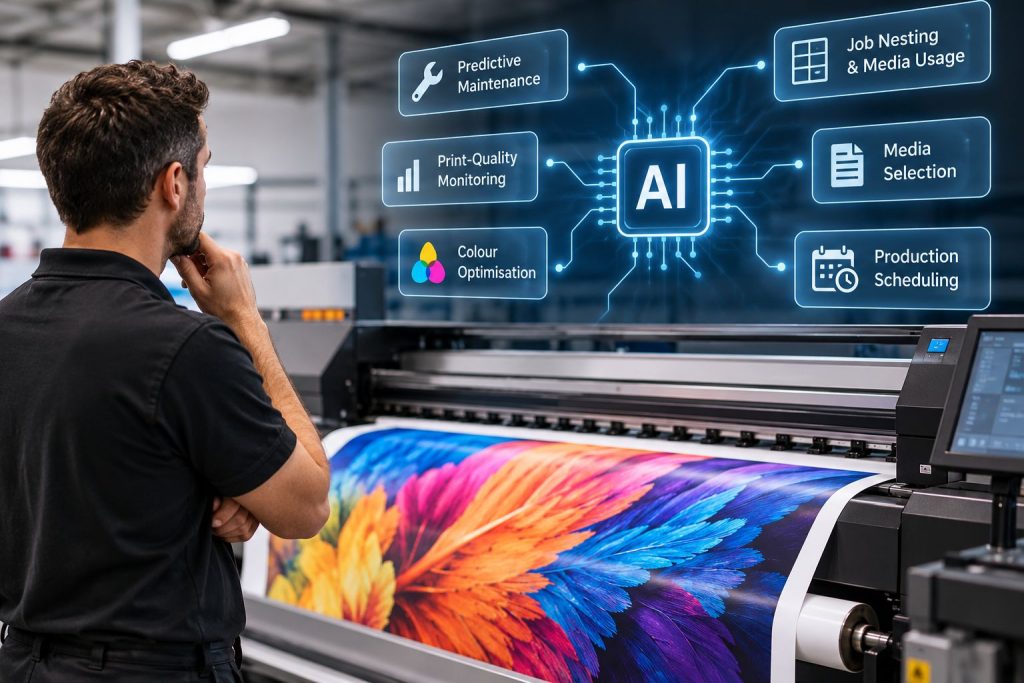
Artificial intelligence in printing is moving beyond design tools and into the everyday operations of print businesses. From processing customer orders to preparing artwork and selecting print settings, AI-powered technology is creating new opportunities to simplify production, reduce manual tasks and help print service providers work more efficiently.
HP is bringing these capabilities together through its integrated AI production solution, combining new features in HP PrintOS Production Hub with the HP Latex R530 AI Printer. For large-format print businesses, this signals a shift towards more connected production workflows, where intelligent software and printing hardware work together to help keep jobs moving.
How Artificial Intelligence in Printing Is Changing Large Format Production
Print businesses often manage a complex process involving customer enquiries, artwork preparation, job creation, print scheduling and production. Manual administration at each stage can consume valuable time and introduce opportunities for errors.
Artificial intelligence in printing can help streamline selected tasks, allowing teams to spend less time on repetitive administration and more time on production, customer service and business development.
HP’s integrated AI production solution focuses on several stages of the workflow, from receiving a customer order to preparing a file and sending a job to print.
AI Order Intake: Simplifying Job Creation
Turning a customer email and its accompanying artwork into a production-ready order can involve several manual steps. HP’s AI production solution includes AI Order Intake, a feature in PrintOS Production Hub designed to convert customer emails or files into orders.
HP reports that the feature can reduce average order creation time by 90%. This could help businesses handling a steady flow of enquiries reduce administrative workload and move jobs into production planning sooner.
The potential benefit is not just faster order entry, but a more streamlined journey from customer request to production.
AI Upscale: Improving Low-Resolution Artwork
Large-format printing can expose limitations in artwork supplied at a low resolution. Images that look acceptable on a small screen may lack the detail required for larger applications.
HP PrintOS Production Hub includes AI Upscale, a tool designed to improve low-resolution files with a single click. This can help print teams prepare suitable artwork for large-format output and reduce delays caused by requesting replacement files or revisiting artwork preparation.
The result still depends on the quality of the original image and the intended output, but AI-assisted upscaling offers another option when working with imperfect source files.
AI-Assisted Print Mode Selection
Choosing print settings often involves balancing output quality with production speed. The ideal settings can vary depending on the application, media and customer requirements.
The HP Latex R530 AI Printer introduces AI Automatic Print Mode Selection, which is designed to recommend an appropriate balance between quality and throughput. By helping reduce the need for operators to make every decision manually, the feature can support a more consistent production process.
This capability is associated with the HP Latex R530 AI Printer and should not be assumed to be a standard feature of every HP Latex R530 configuration. Confirm availability and compatibility with HP or Midcomp before making purchasing decisions.
Connecting Orders Directly to Production
A connected workflow can reduce the number of manual steps between accepting an order and starting a print job.
Direct Job Submission is part of HP’s integrated AI production solution and is designed to connect eligible jobs from PrintOS Production Hub to the printer. Combined with cloud-based production management, this creates a more integrated approach to overseeing jobs and coordinating output.
For print service providers, the value of artificial intelligence lies not only in individual automated tasks, but also in how these tools work together across the production process.
The HP Latex R530: Versatility for Changing Customer Demands
While AI-powered software can help improve workflow management, the printer itself remains central to production flexibility.
The HP Latex R530 is a compact hybrid printer designed to handle both rigid and flexible media. This allows businesses to produce applications such as signage, retail graphics and display boards using one platform.
Key capabilities include:
- Rigid and flexible printing: Support a wider range of applications by working with suitable sheet and roll media.
- Direct-to-board printing: The HP High Control Belt System supports printing on rigid substrates.
- White ink: Expands creative possibilities on supported media and applications.
- HP Pixel Control: Supports accurate colour reproduction and smooth gradients.
- Water-based HP Latex inks: Offer an alternative to solvent-based ink technologies for a range of indoor and outdoor graphics applications.
These capabilities can help print businesses respond to different customer requirements without relying on a single type of media or application.
It is important to distinguish the established HP Latex R530 from the HP Latex R530 AI Printer introduced as part of HP’s integrated AI production solution. The AI printer is associated with the newly announced AI-driven capabilities. Businesses should confirm the exact model, software access and feature availability when evaluating a solution.
What Artificial Intelligence Means for Print Businesses
Artificial intelligence in printing is not a replacement for skilled operators, sound production processes or good customer service. Its value lies in helping teams manage specific tasks more efficiently and make better use of their time.
For print service providers, potential benefits include:
- Less repetitive administration: Automating selected order-entry and file-preparation tasks.
- More connected workflows: Reducing manual handovers between order management and production.
- Greater production flexibility: Pairing workflow tools with equipment capable of handling varied applications.
- More time for growth: Giving teams additional capacity to focus on customers, new services and business opportunities.
The practical results will depend on a business’s existing workflow, order volumes, software access and production requirements. AI tools are most valuable when they address genuine bottlenecks rather than adding complexity to an already efficient process.
Explore the HP Latex R530 with Midcomp
As artificial intelligence continues to influence large-format printing, choosing the right equipment means looking beyond print quality alone. Workflow efficiency, media versatility and the ability to meet changing customer demands all play an important role.
The HP Latex R530 combines rigid and flexible printing capabilities in one compact platform, while HP’s integrated AI production solution demonstrates how connected software and intelligent automation can help streamline print production.
Ready to explore what the HP Latex R530 could bring to your business? Contact Midcomp to discuss your production requirements, explore its capabilities and find out whether it’s the right fit for your next stage of growth.
Sources and Further Reading
- HP’s Integrated AI Production Solution – Wide Format Image
- HP’s AI Production Solution – Image Magazine
- HP AI Production Solution – Video